🇮🇹🇩🇪

MikiLab's recipes

Browse the recipes and make them at home: doses recalculated for the home oven, explained step by step.

MikiLab doesn't want to teach the craft to anyone who has practised it all their life. Hands, flour, the home oven and time always change something.

Sitor's Workshop

176 recipes
Other ways through the recipes

Recipes are of two kinds: those checked or tested by Michele and the drafts written by Sitor, Michele's AI avatar: an artificial intelligence based on Anthropic models. Each recipe clearly states which kind it is.

Free for personal use. Recipes and texts © MikiLab: reproducing or selling them is forbidden, links are welcome. Official prints and shares carry the MikiLab logo.

© MikiLab — Sitor's Manual · Made with Michele's hands

Other languages: use your browser's translator.

Radio

Danese alla Crema (Plunder)

Enter doses, hydration and times. Hydration is computed automatically.

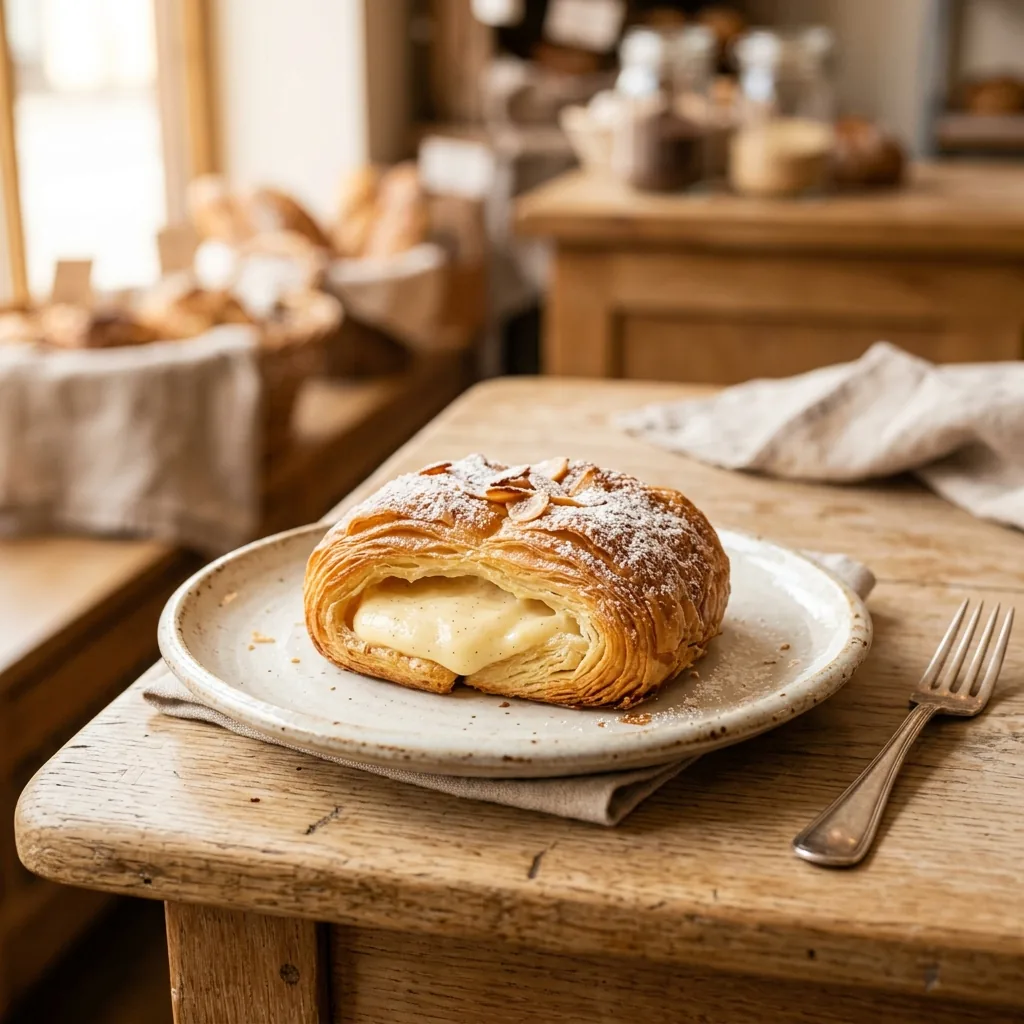
Danish Pastry with CreamIllustrative image
MikiLab
MikiLab
Danish Pastry with Cream · 15/10/2026

Danish Pastry with Cream

Cream Danish (Plunder)

Recipe no. 126 · mikilab.de/126

Flour W300

Sitor draft

MikiLab
MikiLab
Sitor's Manual

Danish Pastry with Cream

Farina W300 · Proof: ~2 h · Difficulty: Challenge
Flour1000 g
Water300 g
Salt16 g
Lamination butter (block)400 g
Butter in the dough60 g
Whole milk, cold100 g
Eggs (in the dough)100 g
Sugar100 g
Fresh yeast40 g
Grated lemon zest5 g
Pastry cream (see recipe)600 g
Fruit or jam for topping400 g
Apricot glaze80 g

Baking: 195°C · 16 min

Method

1) DOUGH (the day before): in a stand mixer with the dough hook put the flour, 300 g cold water, 100 g milk, the eggs (100 g) and the lemon zest, sugar, fresh yeast (40 g) and 60 g soft butter. Mix on low speed 6 minutes, add the salt, then 4-5 minutes on medium until smooth and elastic (final temperature 22-24 °C, use cold or iced water). Shape into a rectangle, wrap and refrigerate (4 °C) for 10 hours. 2) Lamination: shape the butter block (400 g) between two sheets of baking paper into 20×20 cm, at 14-16 °C (bendable but cold). Roll the dough to 20×40 cm, enclose the butter like a book and seal the edges. Do 3 single folds (roll to 3 times the length, fold in three), with 30-40 minutes in the fridge between folds. If butter leaks or softens, chill for 30 minutes right away. 3) SHAPING: roll to 4 mm. For pinwheels: 10×10 cm squares, cut from the corners toward the centre (not all the way), fold every other corner to the middle. For squares: 8×8 cm with a raised rim (score 1 cm from the edge without cutting through). 4) FILLING: in the middle 1 spoon (about 25 g) of cold pastry cream and on top a little chopped fruit or 1 teaspoon of jam. 5) FINAL PROOF: 2 hours at 26 °C, not above 27 °C. Then brush the edges with egg and milk. 6) BAKING: 195 °C (fan 185 °C) for 16 minutes until golden. Right out of the oven glaze the edges with warm apricot glaze. Cool on a rack.

Allergens: Gluten, Eggs, Milk

© MikiLab — Sitor's Manual · mikilab.de · Do not reproduce or sell without the logo and consent

Time & temperature (estimate)

Kitchen temperature:

Stated proof: ~2 h. Mild kitchen → use the stated times.

Warmer = faster. Estimate: exact values added by Michele.

Challenge

On TikTokRecipe no. 126

What you need· draft

  • Scale (1 g)Where: houseware
  • Large bowlWhere: houseware
  • Oven thermometer · optionalWhere: houseware / online

Allergens

GlutenEggsMilk

Always check the labels of your products.

Oven and steam can burn.

Recipes and texts © MikiLab. Free for personal use. Official prints and shares carry the MikiLab logo.

The MikiLab label

No additives
Total fermentation
≈ 2 h
How it rises
direct dough
Baker's yeast
4 % of flour
Salt
1,6 g per 100 g flour
Added fat
46 %
Added sugars
10 %
Flour
Farina W300

Calculated from the recipe: facts about the method, not a nutrition label nor medical advice.

Process diagram

MikiLabDanish Pastry with Cream🥣1. Mixing12 min📚2. Laminationbutter and folds🤲3. Shaping🫧4. Final proof2 h🔥5. Baking195 °C · 16 min🌬️6. Coolingmikilab.de
8°C water48% hydr.1000g flour0h leaven.195° · 16′ StaticIndirect

Ingredients

Rescaleg
How much flour?
Flour1000 g · 100%
Water300 g · 30%
Salt16 g · 1.6%
Lamination butter (block)400 g · 40%
Butter in the dough60 g · 6%
Whole milk, cold100 g · 10%
Eggs (in the dough)100 g · 10%
Sugar100 g · 10%
Fresh yeast40 g · 4%
Grated lemon zest5 g · 0.5%
Pastry cream (see recipe)600 g · 60%
Fruit or jam for topping400 g · 40%
Apricot glaze80 g · 8%

Procedure

1) DOUGH (the day before): in a stand mixer with the dough hook put the flour, 300 g cold water, 100 g milk, the eggs (100 g) and the lemon zest, sugar, fresh yeast (40 g) and 60 g soft butter. Mix on low speed 6 minutes, add the salt, then 4-5 minutes on medium until smooth and elastic (final temperature 22-24 °C, use cold or iced water). Shape into a rectangle, wrap and refrigerate (4 °C) for 10 hours. 2) Lamination: shape the butter block (400 g) between two sheets of baking paper into 20×20 cm, at 14-16 °C (bendable but cold). Roll the dough to 20×40 cm, enclose the butter like a book and seal the edges. Do 3 single folds (roll to 3 times the length, fold in three), with 30-40 minutes in the fridge between folds. If butter leaks or softens, chill for 30 minutes right away. 3) SHAPING: roll to 4 mm. For pinwheels: 10×10 cm squares, cut from the corners toward the centre (not all the way), fold every other corner to the middle. For squares: 8×8 cm with a raised rim (score 1 cm from the edge without cutting through). 4) FILLING: in the middle 1 spoon (about 25 g) of cold pastry cream and on top a little chopped fruit or 1 teaspoon of jam. 5) FINAL PROOF: 2 hours at 26 °C, not above 27 °C. Then brush the edges with egg and milk. 6) BAKING: 195 °C (fan 185 °C) for 16 minutes until golden. Right out of the oven glaze the edges with warm apricot glaze. Cool on a rack.

The why

This recipe's steps explained by Sitor (AI). The quantities stay Michele's.

Machine Sheet

Production Mode: Manual

Hourly Yield: ≈ 40-80 pcs/hour (by hand)

No machine active: manual work. Turn on the Machine Park in the Lab.

Danish-style laminated yeasted dough (Plunder), direct method: lamination butter at 40%, lighter than croissant. Yield: about 28 pieces of 75 g. The long 10-hour chill makes the dough firm and even to laminate. Recipe written by Sitor (AI): a starting point to try.

Useful terms *

  • * Final proof (appretto): the second proof after shaping, before baking.
Michele

Made with Michele's hands

MikiLab 🇮🇹🇩🇪