🇮🇹🇩🇪

MikiLab's recipes

Browse the recipes and make them at home: doses recalculated for the home oven, explained step by step.

MikiLab doesn't want to teach the craft to anyone who has practised it all their life. Hands, flour, the home oven and time always change something.

Sitor's Workshop

176 recipes
Other ways through the recipes

Recipes are of two kinds: those checked or tested by Michele and the drafts written by Sitor, Michele's AI avatar: an artificial intelligence based on Anthropic models. Each recipe clearly states which kind it is.

Free for personal use. Recipes and texts © MikiLab: reproducing or selling them is forbidden, links are welcome. Official prints and shares carry the MikiLab logo.

© MikiLab — Sitor's Manual · Made with Michele's hands

Other languages: use your browser's translator.

Radio

World Bread Day · 16 October 2026

Today MikiLab lights up.

Michele's free recipe book opens its doors to everyone. You make the first cut.

Sitor is an artificial intelligence, not a person. Nothing from this party is saved or sent.

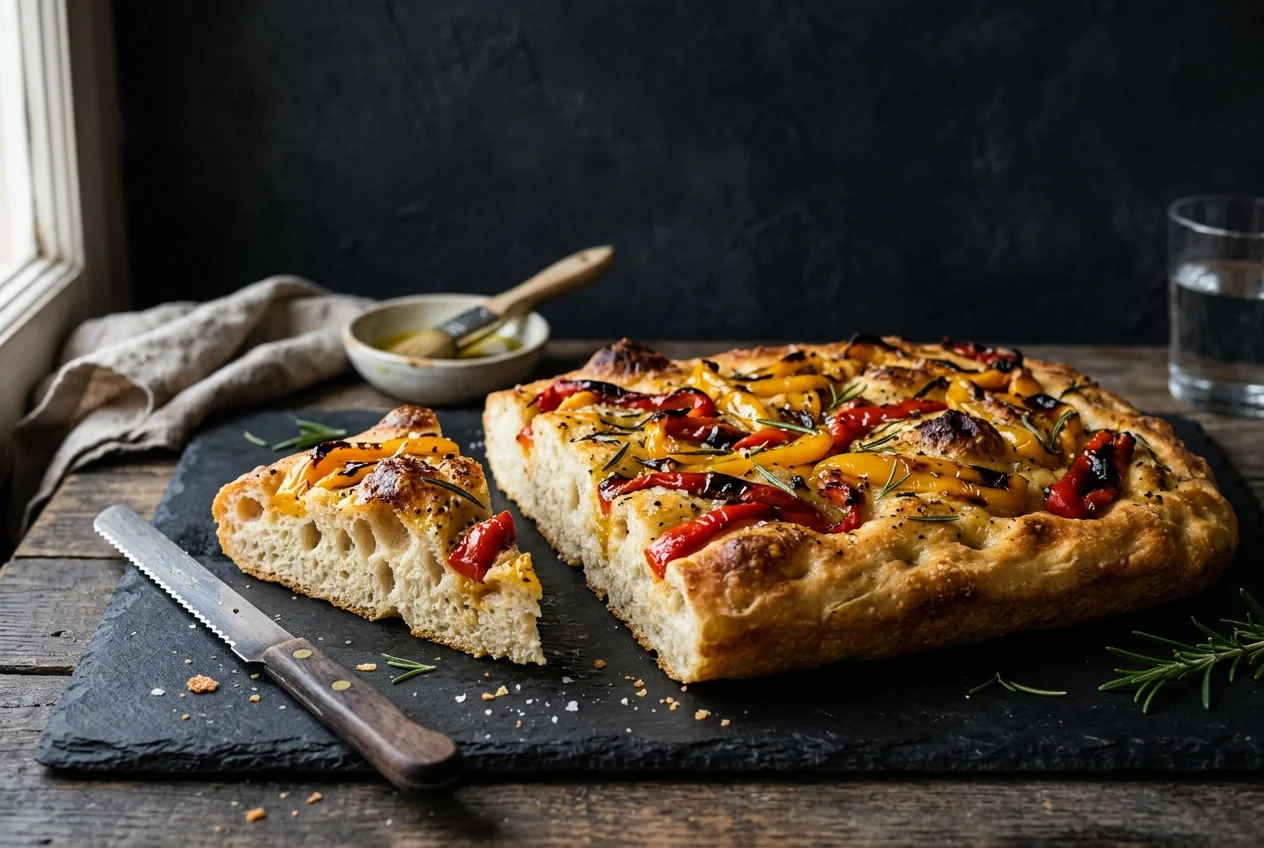
Focaccia Peperoni Arrostiti

Enter doses, hydration and times. Hydration is computed automatically.

Roasted Pepper FocacciaIllustrative image
MikiLab
MikiLab
Roasted Pepper Focaccia · 16/10/2026

🇮🇹Roasted Pepper Focaccia

Focaccia Peperoni Arrostiti

Recipe no. 88 · mikilab.de/88

Durum semolina + type 0

Sitor draft

Michele's touch: soaked breadcrumbs

In all my savoury recipes I add a little soaked breadcrumb, the «Brösel» (German bakers call it an old-bread soaker). It makes the crumb softer, brings crust flavour and keeps the bread fresh longer. Optional: the recipe works without it, but I always do it.

Dry breadcrumbs

50 g

Water

150 g

for this recipe, with 1000 g of flour

  1. The day before: stir the breadcrumbs and water into a soft paste. Cover and keep it in the fridge overnight.
  2. The next day: add all the paste to the final dough (not to the preferment), with the other ingredients. The recipe's water stays the same.

Use plain breadcrumbs, with no salt or seasoning. Best of all is your own bread from yesterday, dried and grated.

MikiLab
MikiLab
Sitor's Manual

Roasted Pepper Focaccia

Semola rimacinata + tipo 0 · Proof: ~4 h · Difficulty: Easy
Flour1000 g
Water750 g
Salt20 g
Boiled potato, mashed (cold)200 g
Fresh yeast (final dough)3 g
Barley malt10 g
Natural improver (optional)30 g
Extra virgin olive oil (in the dough)40 g
Extra virgin olive oil (in the tray and to finish)100 g
Roasted peppers220 g
Taggiasca olives120 g

Baking: 230°C · 24 min

Method

1) POOLISH, the evening before: 300 g flour, 300 g water and 1 g fresh yeast. Mix to a smooth batter, cover and leave 12-16 hours at 18-20 °C. Ready when domed and full of bubbles. 2) POTATO: boil 250 g floury (yellow-fleshed) potatoes with the skin in salted water for 25-30 minutes until tender. Peel and mash them while still warm with a ricer (you need 200 g). Cool below 30 °C: hot, they kill the yeast. 3) DOUGH: put the poolish, 400 g cold water (keep 50 g aside), 700 g flour, 3 g fresh yeast, the malt and (optional) the improver in a bowl or stand mixer. Mix 5 minutes and rest 20 minutes. Add the salt (20 g) and the potato, then the remaining water gradually and finally the oil (40 g), until the dough forms strands. Very soft and sticky: that's right. Final temperature 23-25 °C. 4) FOLDS: 3 sets of folds, one every 30 minutes, with wet hands. The dough gradually becomes smoother and stronger. 5) TRAY: oil two 40×30 cm trays with 30 g extra virgin olive oil each. Divide the dough into two (about 1 kg each) and stretch it with oiled hands, without forcing. If it springs back, rest 15 minutes and continue. 6) FINAL PROOF in the tray: 2-3 hours at 24 °C, covered. Ready when doubled, puffy and full of bubbles, and a finger dent springs back slowly. 7) TOPPING: wet your fingers with oil and dimple the whole surface. Roast the peppers, peel and cut into strips; pat dry well. Spread before baking: roasted peppers and Taggiasca olives. Finish with a drizzle of oil (about 20 g per tray) and flaky salt. 8) BAKING: static oven preheated to 230 °C, lower shelf, for 24 minutes, until the base is crisp and the top golden. Unmould onto a rack and serve lukewarm.

Allergens: Gluten, Lupin

© MikiLab — Sitor's Manual · mikilab.de · Do not reproduce or sell without the logo and consent

Time & temperature (estimate)

Kitchen temperature:

Stated proof: ~4 h. Mild kitchen → use the stated times.

Warmer = faster. Estimate: exact values added by Michele.

Easy

Draft written with Michele's method (poolish, mashed boiled potato, a drizzle of oil to finish, in a tray). To try: once Michele confirms it, this notice disappears.

On TikTokRecipe no. 88

What you need· draft

  • Scale (1 g)Where: houseware
  • Large bowlWhere: houseware
  • Oven thermometer · optionalWhere: houseware / online

Allergens

GlutenLupin

Always check the labels of your products.

Oven and steam can burn.

Recipes and texts © MikiLab. Free for personal use. Official prints and shares carry the MikiLab logo.

The MikiLab label

Long fermentationPrefermentVery little yeastSugar: noneNo eggsNo additives
Total fermentation
≈ 16-20 h
How it rises
poolish of 12-16 h
Baker's yeast
0,4 % of flour
Salt
2 g per 100 g flour
Added fat
14 %
Flour
Semola rimacinata + tipo 0

Michele's method: the preferment or sourdough works at least 12 hours. More flavour, longer keeping, less yeast.

Calculated from the recipe: facts about the method, not a nutrition label nor medical advice.

Process diagram

MikiLabRoasted Pepper Focaccia🫙1. PrefermentPoolish🥣2. Mixing12 min⏳3. Bulk rise1,5 h🤲4. Shaping🫧5. Final proof2,5 h🔥6. Baking230 °C · 24 min🌬️7. Coolingmikilab.de
Pre-dough (Biga/Poolish)20°C water75% hydr.1000g flour1.5h leaven.230° · 24′ StaticIndirect

🥖 Phase 1 · Poolish (evening before)

Flour300 g
Water300 g
Fresh yeast1 g

12-16 h at 18-20°C

Phase 2 · Main dough

Rescaleg
How much flour?
Flour700 g · 70%
Water450 g · 45%
Salt20 g · 2%
Boiled potato, mashed (cold)200 g · 20%
Fresh yeast (final dough)3 g · 0.3%
Barley malt10 g · 1%
Natural improver (optional)30 g · 3%
Extra virgin olive oil (in the dough)40 g · 4%
Extra virgin olive oil (in the tray and to finish)100 g · 10%
Roasted peppers220 g · 22%
Taggiasca olives120 g · 12%

Procedure

1) POOLISH, the evening before: 300 g flour, 300 g water and 1 g fresh yeast. Mix to a smooth batter, cover and leave 12-16 hours at 18-20 °C. Ready when domed and full of bubbles. 2) POTATO: boil 250 g floury (yellow-fleshed) potatoes with the skin in salted water for 25-30 minutes until tender. Peel and mash them while still warm with a ricer (you need 200 g). Cool below 30 °C: hot, they kill the yeast. 3) DOUGH: put the poolish, 400 g cold water (keep 50 g aside), 700 g flour, 3 g fresh yeast, the malt and (optional) the improver in a bowl or stand mixer. Mix 5 minutes and rest 20 minutes. Add the salt (20 g) and the potato, then the remaining water gradually and finally the oil (40 g), until the dough forms strands. Very soft and sticky: that's right. Final temperature 23-25 °C. 4) FOLDS: 3 sets of folds, one every 30 minutes, with wet hands. The dough gradually becomes smoother and stronger. 5) TRAY: oil two 40×30 cm trays with 30 g extra virgin olive oil each. Divide the dough into two (about 1 kg each) and stretch it with oiled hands, without forcing. If it springs back, rest 15 minutes and continue. 6) FINAL PROOF in the tray: 2-3 hours at 24 °C, covered. Ready when doubled, puffy and full of bubbles, and a finger dent springs back slowly. 7) TOPPING: wet your fingers with oil and dimple the whole surface. Roast the peppers, peel and cut into strips; pat dry well. Spread before baking: roasted peppers and Taggiasca olives. Finish with a drizzle of oil (about 20 g per tray) and flaky salt. 8) BAKING: static oven preheated to 230 °C, lower shelf, for 24 minutes, until the base is crisp and the top golden. Unmould onto a rack and serve lukewarm.

The why

This recipe's steps explained by Sitor (AI). The quantities stay Michele's.

Machine Sheet

Production Mode: Manual

Hourly Yield: ≈ 40-80 pcs/hour (by hand)

No machine active: manual work. Turn on the Machine Park in the Lab.

MikiLab method: poolish the evening before, mashed boiled potato in the dough (keeps the crumb soft and moist for days), a drizzle of oil in the dough and one to finish, baked in a tray. Yield: 2 trays 40×30 cm. The topping changes, the dough stays the same. No poolish or yeast? See «I don't have this ingredient». Rewritten by Sitor (AI) with your method: a starting point to try.

Useful terms *

  • * Poolish: a liquid preferment (equal parts flour and water + a little yeast), ripens 8-16 h; adds aroma and softness.
  • * Full development (incordare): knead until the dough is smooth, elastic and pulls away from the bowl (gluten fully developed).
  • * Final proof (appretto): the second proof after shaping, before baking.
Michele

Made with Michele's hands

MikiLab 🇮🇹🇩🇪